
25. Creating Diversity & Inclusion in the School Enrollment Process & Beyond
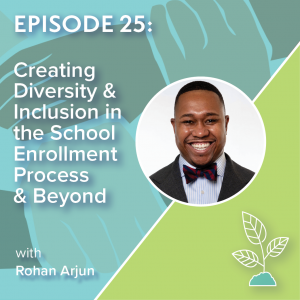
In this episode, we are joined by Rohan Arjun, a seasoned admission professional, diversity practitioner, and educational consultant. Through his work, Rohan is devoted to prioritizing diversity, inclusion, and POC representation in small schools, strengthening community, and enriching every student’s educational experience and ability to thrive.
Podcast: Play in new window | Download
Subscribe: Apple Podcasts | Spotify | Amazon Music | RSS
About Rohan Arjun:
A seasoned admission professional, diversity practitioner, and educational consultant, who is currently the Director of Enrollment Management and Financial Aid at Friends Select School in Philadelphia, PA. He has more than a decade of experience working in independent schools and is passionate about enrollment management, supporting schools in their equity and inclusion work, as well as branding and marketing. Outside of his professional work, Rohan enjoys spending quality time with his family and friends.
Find Rohan Arjun:
The following content has been automatically generated by an AI system from the audio recording of this podcast. We cannot guarantee the accuracy, or completeness of the information provided, and we apologize for any errors.
Aubrey: Welcome to Mindful school marketing, your go-to podcast for personal and professional growth.
Tara: We’re school marketers, business owners and moms passionate about connecting other school professionals with tools and strategies for success.
Aubrey: We love solving problems, exploring new ideas and thinking outside the box, let’s transform your school in life. Starting right now. Welcome to Mindful School Marketing. I’m Aubrey Bursch.
Tara: And I’m Tara Claeys. Today we’re joined by Rohan Arjun.. Rohan is a seasoned admission, professional diversity practitioner and educational consultant who’s currently the director of enrollment management and financial aid at the Friends Select School in Philadelphia, Pennsylvania. He has more than a decade of experience working in independent schools. And he’s passionate about enrollment management, supporting schools in their equity and inclusion work, as well as branding and marketing. Outside of his professional work, Rohan enjoys spending quality time with his family and friends.
Aubrey: Welcome. We’re so glad you’re here. Thanks for joining us.
Rohan: I’m so excited to be here today. Thank you so much, Aubrey and Tara for having me.
Aubrey: And thank you for being our guest. We truly are excited that you’re here now. I’m so curious. I mean, looking at your bio and everything that you’ve done, can you tell us more about yourself and your role?
Rohan: Happy to. I am, so I’m originally from Jamaica, I’m Jamaican and Indian, hence my first and last name. And so when people see my name on paper there. They, they are imagining and expecting to meet an Indian man. Not necessarily a man that is presenting as African-American. And again, like I said, I’m Jamaican an Indian, so that’s, that’s where that comes from. So people who know the origin of both my first and last name, it could get a little confusing. So like I said, originally from Jamaica, I was born there, moved to Philadelphia when I was seven. My dad left shortly after. I was born because he wanted to come to the states, you know, American dream, the streets are paved with gold, maybe not to that extent, but he wanted to essentially provide a better life for his children.
And so I moved when I was seven and went to public schools up until eighth grade and we moved to Philadelphia. And I think I just got lucky. My eighth grade English teacher had a friend that worked at George school, told her about all of the opportunities there. She sent a handful of her best students to the open house.
And, one of my friends realized they couldn’t go home. And everyday they said, absolutely not. And my, my dad was really excited about this opportunity and we were fortunate that we met this admission professional, Rachel, at that time, Speller who took my family by the hand, she walked us through the entire process, the application process, the financial aid process, the SSAT testing the interview and I was fortunate to be named the Philadelphia scholar of 2001 and got a full scholarship to George School. That was the only way that a George school education and experience would be a possibility or a reality for my family. Years later, many years later, actually right before I returned to George school to work, I was visiting. And I found out that the Philadelphia scholar was Rachel’s brainchild. She was trying to recruit more kids from like inner city, Philadelphia. And so in hindsight, she literally had a hand in every aspect of me coming to George school to be a student. And that opportunity changed my life. I credited with why I have found my calling in admission enrollment management, and specifically in independent schools helping to create access the same way that Rachel did for me as a kid. My current role I’m director of enrollment management and financial aid at Friends Select School in center city, Philadelphia, and I am loving it. I’m new to the community. I’ve only been here since July, but I feel like I’m already making an impact in certain ways. And there are other areas of the role that is stretching me and keeping me humble if you will.
Tara: What an interesting story are you still in touch with Rachel? Does she know what you’re doing, you’re doing this and that you’ve inspired, she’s inspired you so much.
Rohan: I think she knows. We do, we do- we’re friends now. She looks exactly the same as she did when I was an eighth grader. Believe it or not. I don’t know what the fountain of youth is or where it is there she found that. I like to believe that working with kids is what keeps us young. And so I’m hoping that many years later there’s going to be a eighth grader. That’s going to come back and say, Rohan, you look exactly. The way you did when you interviewed me as a kid. Yeah.
Tara: And that you inspired them and change their lives similarly, right, you’re paying that forward. What a great story and what a great person, Rachel sounds like she was to, to have such an impact on your life. I’d love to ask you a question about diversity and inclusion since that’s part of what your introduction focused on. And I know there have been so many changes recently. I mean, certainly. The past many years of our history in this country, but specifically in the past couple of years when it comes to diversity and inclusion in schools. And there’s been a lot of conversation around that. Can you tell us a bit about what you’ve seen changing in general? And also specifically, I know you haven’t been at that school for very long, but just in your role, in independent school?
Rohan: Absolutely. That’s a great question, Tara. The, in terms of the, I work in independent schools specifically, we’ve come so far, but we have so far to go. I think about independent schools. They, they weren’t created for people who looked like me, right? And as time went on, they realized that whether it was by choice or for some involuntary reason, they realized that they needed to be diverse, but they didn’t know how to go about that. In, in many of the schools you find that they just thought we, we will allow for students of color to apply. That’s not really how that works. Again, these schools weren’t that created or established for them. And, but why, why would they choose to come to these spaces where they’re going to be the only ones then you found schools were leaning into those access organizations, which ABC was the one, A Better Chance was the one that was probably the most known and one of the first to start doing placement of students of color. And so then you had schools that were partnering with them and then they’d bring in one student for instance. But again, the student in a place where it wasn’t established for them. They don’t see other students that look like them. They don’t see faculty and staff or administrators that look like them. They don’t see board members that look like them. The curriculum is not a space that they affiliate or find the affinity. There were a number of those students in their early days who. For whatever reason, whether it was by their own choice or because they needed to be coached out because coming into these communities and not knowing those written and unwritten rules, not having food that they were used to or having the, the resources that they needed to get the full experience at the school, it just didn’t work. Luckily over time that has changed, but it was definitely through the work of some very passionate educators and, and being able to help schools understand that there’s, there’s more to recruiting students of color, right? Making sure again, they, they saw themselves in all of those different constituents within the school, making sure that they were set up for success. You know, financial aid is not just about the tuition. It’s about everything that, that child, regardless of how they identify is going to need to be successful. So books nowadays, laptops, you know, those, those required trips, whether it’s the choir goes on an international trip to, to perform every other year in Rome or, or somewhere else. And, you know, what does that look like? Are you supporting the child and be able to, to accomplish that requirement? The same thing, if they’re playing on a sports team or a part of another extracurricular activity and the whole team, or the whole club is, getting a t-shirt and shorts or something like that. Like, are you supporting them to, to get that full experience as well? And so there there’s so much growth, but like I said, in the beginning, there’s so much more for us to do. The fact that now you have at a lot of our schools, not all of them, someone who is a responsible and for holding the institution accountable for DI effort. That’s huge, you know, for so many years in schools, it was the, uh, the teacher who identified as a person of color who was teaching Spanish or math or science or something like that. And then they, a part of their contract was this part-time DI coordinator or something like that. But DI is not a part-time job. You have to make sure that you are positioning that person to be successful in holding the institution accountable, right? And so you’re seeing more schools are moving in that direction. More schools have DI directors who have a seat at the table, and they’re a part of the senior administration team. They report to the board they’re there when those policies and those, uh, those rules and those changes are happening and can help the school to look through a DI lens when making those decisions, they are. Receiving budgets that are allowing them to do this work intentionally and purposefully, to be able to bring those speakers in or provide faculty and staff with, with the professional development that they need to get those skills and tools into their tool boxes. They are the, uh, budget that allows them to bring in those speakers for the entire school to be able to send students to conferences like the student diversity leadership conference and so forth. And so those are the areas that we’re, we’re seeing gradual change in most recent years, you know, the blackout accounts, the, what happened with George Floyd. That really kicked this work into high gear, you know, there, and the sad part is, is that it took that the blackout movement and the loss of George Floyd for, for it to get the attention that it needed. Because unfortunately, a lot of those testimonies and stories that we saw on the blackout accounts were ones that. Students had been telling for years and either no one was listening or they listened, but they didn’t hear, they didn’t do anything about it to, to change, to make those changes. And so there were alumns my age older than me that would read some of those posters, those poles. And they would say I had that very same expense. And it’s sad that, that was still happening now. And so that made for a tall order because families were starting to ask those tough questions and they didn’t just want to know what you were doing. They wanted to know how long you had been doing this. Is this reactionary as a result of a blackout account, or is this something that is a part like at your what you believe in, what you support and what you, the, the community and the culture that you’ve created within your school communities.
Aubrey: Amazing. That there’s so much that has changed, but still so much yet to change. I mean, I was writing furiously as you were talking and I’m thinking like, how are you supporting the child in the full experience? Like, you know, DI as a full-time job and having a seat at the table is just huge. And yet, you know, I can sense from your conversation that there’s, there’s, from your words, that there’s so much more to, to go. Like so much more, you know, things that we need to be doing in independent schools. And I guess that leads me to my next question. So as we’re thinking about enrollment, you know, and, you know, diversity equity inclusion, what are some things that independent schools need to do to improve their enrollment process?
Rohan: When it comes to diversity, there’s so much that schools can be doing in. With anything, it, it comes down to how much you value a certain initiative, right? And you’ve showed that through the resources that you’re willing to allocate to it. The time and the finances are probably the most, the easiest ways to show, but also the hardest ways to show her, because it requires a commitment, a vision, a strategy, and it almost has to be top down, from the board and from the head. And so when you think about improving the enrollment process, when it comes to diversity, there there’s so many ways that you can, you can approach this, right? Making sure that your website and your collateral material reflects the community, that you are making sure that the admission process is accessible to everyone there. You know, as long as these schools have been around the amount of students that have attended these schools, there, there’s always going to be that first-generation family that just does not even know where to start. And when you think about all of the pieces of the process, which on the admission side and on the school side, we understand that to be essential and necessary so that we get a sense of who the whole child is, because that’s what we say, we’re educating the whole child. So we need to know who the whole child is. So the application, the parts for the parent or guardian and the students to complete the, the grades, the teacher recommendations, the test scores, the interview, the tour, all of these different things are helping us to, to get to know who this child is and, and hopefully figure out can we support this whole child? When they bring their whole self, because hopefully these schools are creating communities and spaces where the student can show up as their whole selves and contribute to the community. Because at the end of the day, students are not empty vessels. They’re coming in with their lived experiences, their beliefs, their values, the things that their families, their schools, their religious institutions, if they are religious, their neighborhoods. Their ethnicity, all of those things have instilled in them. And so when, when you admit a student, you are admitting all of that and schools need to recognize that it is a, it is an honor, and it is a privilege to have those students come into your community because just their presence will not only enrich the community, but also the learning and so, again, going back to making sure that the process is accessible to all making sure that the, the, those in the admission office are speaking the school’s truths and helping families to understand who the, the school and the community truly is, is going to be improved. Because that can be a, an attrition issue when you sell the school as one thing, the families show up and it’s not exactly what they signed up for, you know? And when you think about the time, the energy and the resources that it takes to fill a seat like that, that’s part of what schools have to think about. And those who are in those positions. Of power needs to think about when you’re talking about making sure that you are presenting the school in an accurate light so that families know the community, that they are joining, the experience that they are about to have. And this works on both sides, right? Like making sure that if you are like, if you’re speaking to a female student and you were a. Single sex boys’ school before that has since became co-ed like, what is that experience going to be like for the female student? Thinking about the, the student that identifies as a student of color. What is that experience going to be like for them? Are they going to see themselves throughout the community? Are they going to see themselves in the student body and the faculty, the staff, the administration, the board. Are they going to see themselves in the hallways when they’re walking around, like in the pictures that are reflected on the walls or are they going to be constantly reminded that they are a guest in this space, as opposed to at home in this space? And it’s also about those families who aren’t exactly high on DI initiatives. So those schools that are doing a lot of the I work and is committed and they’re like, this is who we are, making sure that those families know that as well, because when they show up and they’re like, wait, whoa, whoa, whoa, whoa. We picked this school because it was diverse- we love that. Did not know that there were going to be courses or speakers or anything, did not know you’re going to try and indoctrinate and brainwash my child. And what is this critical race theory and all of that, like making sure that families, regardless of who your school community is, they’re getting an accurate picture of them. I feel like I should also just add in, because I mentioned critical race theory that nobody pre-K, the 12 is teaching critical race.
Tara: Thank you for clarifying that. Yeah, that’s important to say. I mean, yeah,
Rohan: That is a graduate level course law course at that and people have been conflating this idea to create fear and to, to get a following around trying to prevent the, DI work from being done. Because that’s, that’s what schools are doing, that, that have been accused of doing teaching critical race. There, they are having the difficult conversations about making sure that people are treated fairly and equally and have equitable access and, and trying to help create global citizens and conscious citizens who are going to contribute to the world. They are not teaching critical race theory. So anybody that’s listening, I hope, I hope that came through loud and clear. Critical is not being taught in any pre-K to 12.
Tara: I appreciate your clarifying that I know there’s, there is a lot of misconceptions out there right now, especially. So I appreciate your clarifying that and sharing all this with us. I have so much going through my head right now, and I’m just thinking about, you know, the, all the different things that are packed into, your role or other than the role of admissions and enrollment and marketing at independent schools right now, because there are these different things you’re trying to, you’re trying to do the right thing and make your schools inclusive and diverse. And then you’re also, you know, battling these misconceptions. So that makes it really hard. And I’m going to, I’m going to talk about marketing because that’s kind of what we talk about, but I don’t want to belittle, the overall goal that is happening here by, by talking about marketing specifically. So I’m going to try to kind of combine that a little bit in my question. In terms of how marketing relates to, to these goals, it’s both something that I think schools want to communicate in their marketing. You know, I know when I work with schools on their websites, they want to be sure that the images that we show indicate that they have a diverse population. And hopefully that’s true and reflective, as you said, you have to deliver on what you’re showing as well. So that is something that I think most schools feel is a benefit that they want to communicate, and that they have to deliver on but what other marketing strategies are impacted on and I’m thinking also about outreach. So if you’re trying, you said, make your admissions process accessible. When you talk about people of color, kids of color, not seeing themselves in the environment, they might not even really know that it’s there for them. So I’m wondering as part of your marketing strategy combined with your goals for diversity, how you also market to populations that might not typically be the populations that know about independent school.
Rohan: Absolutely another great question. I, so it’s, it’s important when you, when you talk about website to collateral material, to social media and so forth, you know, schools do want to make sure that their pictures reflect a diverse community, whether they have it or not. And families can tell when you’re staging these pictures and it’s the same little black or brown kid that is in every single picture, or you hear the stories where on the website and in the, in the view book or in the catalog, like there seemed like there were so many and I showed up on campus and I realized it was me. I am the diversity. And so because schools recycle pictures and they’re, they’re pictures of kids who have graduated and gone on to college and have graduated. So, so making sure that again, it is reflective of who your community is, is going to be important. It’s also about, again, going back to the resources that you are willing to, to invest in these initiatives. So I think about when I was working at St. Mark’s, for instance, in south where Massachusetts, my summers could have easily had four weeks off, but I spent the summers going and leading with access organizations that had summer programs, boys club of New York Oliver scholars, when they did their panel teak fellowship you name it, White Foundation in Newark, New Jersey and New Jersey Seeds and so forth. And I really allowed them to, to dictate what my visit looked like. So whether it was, I was coming and I was sitting in on their programming and their classes, I was going on with tour. I had an opportunity to speak to kids or not. I was doing the interview and visit etiquette class for the kids. So it, it showed my commitment and my investment in the program, but also in their students and their scholars. And that increased the relationship that I have with those programs, which meant that, so on one end, when those scholars saw me at school fairs in the fall, they, they recognize me. There was already a connection there. Then you think about the fact that again, I invested in them knowing that. St Mark’s and is not going to be able to accept all of the scholars that I’ve met with over the summer, but they were equipped with the tools around how to navigate their tours, how to navigate their interviews, how to prepare for those interviews, doing their research, the same way that an adult would do their research on the organization or a company before going into an interview. Having questions already prepared, not, not answering with one word answers. From handshake, eye contact, how they should dress, like all of those kinds of things. So that investment was there, but it also translated to the, to the organization themselves, where now I have this relationship with those gatekeepers, if you will, who helped families to create their lists for which schools to go to. It was also about creating opportunities for charter schools and the, and access to organizations to send their placement people to our school, to see what we do, how we do aware we do it and how we support their scholars once they’re a part of our community, for instance. So that way, when they were sitting down with those families, making those recommendations, they were making those recommendations through an, through an accurate perspective of who the school is and their experience. I also think about the fact that the receptions, that I would partner with the Boys Club of New York to host for instance, and I would be able to invite not only Boys Club kids, but kids in New York city who, anybody that wanted to come. So regardless of how they identify, but it was, it was the, the location. It was at the Boys Club. So it was easily accessible to the families who are familiar with the Boys’ Club, but then there was also a level of comfort as well, because there was a place that they were used to. And then in term, again, anybody, regardless of how the identified was welcome to come, if they lived in the city of New York, they got an invitation. And so you, you would also see like which families were willing to come to this reception when it wasn’t at like the racket club of X, Y, and Z, or add this ballroom and this hotel or something like that. And so, again, communicating to the community that we’re trying to reach this, but it’s also not just about recruiting kids of color, whose family are, are identified as low income, right? So I think about the work that I did at my most recent school, where we researched these zip codes where like the, I think it was, I’m trying to remember the terminology, but essentially it was zip codes with affluent black and brown families where they live. And so doing targeted marketing on social media, for instance, through like Facebook and Google ads and Instagram, that target that pinpointed those zip codes to make sure that we are able to, to reach those families as well, who would not necessarily know who we were. And so those are some of the things that I think about when thinking about marketing specifically through like a diversity lens, right? And at the end of the day, just going back to speaking your truth and accurately representing yourself.
Aubrey: Thank you so much for sharing. I’d love to know, thinking about mindfulness and how it applies to, you know, we apply it to marketing and school enrollment environments. I’m curious, what do you think are some mindful approaches school marketers can consider and implement to help them with the challenges they are facing when it comes to enrollment, retention, diversity and inclusion?
Rohan: That is a big question. Hmm. Mindfulness. Honestly, I think the way I think of mindfulness, it’s, it’s a part of like self care. So the same way we would think about what it is that we need to do to take care of ourselves. I think about my mentor and brother, Rodney Glasgow, who, who talks about just like on the plane, where it says you have to put your oxygen mask on first, before you can help others. I think, I think about that. So in order to do that I think the school needs to do some, some soul searching to figure out who they are, do that self care to be, to be true to yourself around who are you as a community, who are the, the hosts in these communities, who are the guests in these communities? And, and also figuring out like who can you fully support in their true identities and their, their full, authentic identities, right? Because that’s when you’re going to be able to accurately. Market who you are to the rest of the world. And that’s when families are going to, to see something in your community that they want to be a part of and see in your community, their children and their families themselves. And so when I think about mindfulness, when it comes to marketing for, diversity, equity, inclusion and enrollment and retention. I think that is the, the biggest part. And you know, when you do that, that soul searching, you may not like who you see. And so it, then it’s about investing the time, the energy, the resources to, to become the school community that you want to be. And that that’s not going to be easy. And just with anything else, when it comes to change, it’s going to be difficult. And they’re definitely going to be people that are going to push back. But they’re also going to be people who are going to say, you know what? This was not the school community that I signed up for whether they are saying this as a board member, administration faculty, staff, students, family. And you’re just going to have to be okay with that. If you are truly committed to become the school community that you know, you can be and that you want to be. So that, that’s what I think about when I think about mindfulness, because at the end of the day, you want to create spaces where everyone that is a member of the community feels at home fields taken care of so that they can show up in their true, authentic selves every day, they can be their best selves because that’s when they’re going to produce their best as well. And when you think about it on the student side of things, they, you know, we all want when they graduate and leave our communities to be the best versions of themselves. And we know that includes some stretching and some bending as well, but in order for them to be willing to stretch and to bend, we have to be taking care of them.
Tara: I am so grateful for all that you’ve shared with us. I’m just, I really appreciate all the thoughts that, that you’ve put out there and value them really. And I’m sure the friends school is so lucky to have you, uh, we’re going to move on now to some questions that we ask all of our guests and I’m going to combine two of them because they’re kind of related and you’ve touched on it a little bit, but these are more related to you than to marketing. So, what are the most important things that you can do to grow professionally and personally, and also, what do you do to be more mindful?
Rohan: So I would say the, the most important things that you can do personally and professionally to grow, you know, reading. I take advantage of conferences and amazing podcasts, like the Mindful School Marketing podcast, EMA all of these different spaces that provide all these, these great resources for us to be able to grow. My own personal mindfulness and self care- I, I go to the barber weekly. Well, every Friday after work, I am at the nail salon and getting a manicure and pedicure biweekly. I listen to music all day in my office. Like these are just some of the ways that I fill my cup. I’m also an extreme extrovert. And I, I love being around people with good energy. It doesn’t matter what we’re doing. As long as the energy is good, laughing, playing cards, watching a show. It doesn’t matter.
Aubrey: That’s awesome. Thanks so much for sharing. Now, we’re going to dive into our rapid fire questions. Don’t worry. They’re gonna be super fun. If you could put one book as mandatory reading in the high school curriculum, what would it be?
Rohan: That probably would have to be Claude Steele’s, Whistling Vivaldi.
Tara: All right. Thanks. Next question. What is one app you couldn’t live without?
Rohan: That’s a tough one. If it, if we’re not necessarily talking about a fun app that anybody’s really going to be excited about, it’s probably my Google calendar, because if it’s not on my calendar, it doesn’t exist. I need anybody that sends me a calendar invite to put that reminder in there as well, that 10 to 15 minute reminder. Cause again, it doesn’t, it doesn’t exist. Yeah.
Aubrey: Not the first one who mentioned that. So they love their Google calendar. I too, live by it as well. What are you reading right now?
Rohan: That is a great question. So I found that most recently I’ve been reading more so for fun, as opposed to learning and growing as, as, as a part of that self care, right? Part of it is-
Tara: You’re probably getting a lot of applications. That’s probably what you’re really reading.
Rohan: Oh yeah. January, February. And so I listen to audible and, and normally the problem is, is I’m listening to it in the morning when I’m doing my morning routine, getting ready or I’m driving. And so when I’m, when I’m listening to those books where I’m learning. I need to take notes and bookmark, which, which isn’t exactly easy when you’re driving. And probably not the safest thing. And so the, the book that I’m currently reading was actually a book that we’re reading as a faculty and staff at friends select. We had the speaker come to do our in-service day at the beginning of January, and that is more so around learning, growing, and learn, uh, learning, growing. And so, it’s In The Shadow of the Ivory Tower, how universities Are Plundering Our Cities. And so it’s been a book that I, I dove into. We were only supposed to read certain parts of the book when I got home. So I highly recommend it. I’m probably going to butcher his name, but it’s Dr. Davarian L. Baldwin.
Tara: Hey, thank you. We will put that on our good reads list. Okay, last question. What is one great piece of advice that you’d like to leave us with Rohan?
Rohan: Honestly, it is too, I am a firm believer that everything that we do comes back to building, managing, and maintaining relationships, whether it is personally or professionally. And so I always encourage people to invest in those relationships.
Tara: Thank you.
Aubrey: Great advice. Thank you so much for being a part of our podcast. We’ve loved having you, where can our audience find you?
Rohan: They can find me, first on Friends Selects website and, then they can certainly find me on social media. I am on Facebook, Instagram, Twitter, LinkedIn, you name it. I’m probably on there and would love to follow them back and learn from their journeys.
Tara: Thank you. Thank you so much for joining us. Hope to meet you in person sometime take care. Thanks for joining us on the mindful school marketing podcast.
Aubrey: We’d love it. If you pop into iTunes and leave a review, five star preferred, let us know how you like the show. It helps us improve what we’re doing and helps others find us too!
Sing Up For Updates via Email
"*" indicates required fields