
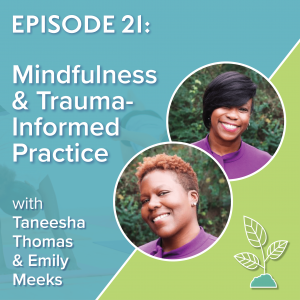
21. Mindfulness and Trauma-Informed Practice with Taneesha Thomas & Emily Meeks
In this episode, Taneesha and Emily talk about how you can create a more supportive environment for students, teachers, staff, and parents at your school through trauma-informed practice, mental health awareness, and equitable instruction. They also share their strategies for being more mindful at school and at home.
Podcast: Play in new window | Download
Subscribe: Apple Podcasts | Spotify | Amazon Music | RSS
About Taneesha Thomas & Emily Meeks:
Taneesha Thomas and Emily Meeks are “teacherpreneurs,” headquartered in Atlanta, GA. The organization, Focused Minds Education Group, provides mental health awareness training using trauma-informed practices to educators and professionals in the workplace.
Show Notes
Books
The Four Agreements, by Miguel Ruiz
The 48 Laws of Power, by Robert Greene
Is Your School An A.S.S.E.T.? by Focused Minds Education Group
Apps
The following content has been automatically generated by an AI system from the audio recording of this podcast. We cannot guarantee the accuracy, or completeness of the information provided, and we apologize for any errors.
Aubrey: Welcome to Mindful School Marketing. I’m Aubrey Bursch.
Tara: And I’m Tara Claeys. Today, we’re joined by Taneesha Thomas and Emily Meeks of Focused Minds Education Group Taneesha and Emily are teacherpreneurs headquartered in Atlanta, Georgia. The organization Focused Mind’s Education Group provides mental health awareness and training using trauma-informed practices to educators and professionals in the workplace.
They teach about using literacy to heal and build skills. Welcome, Taneesha and Emily. Thanks so much for joining us.
Emily: Hi, thanks for having us.
Taneesha: Hey guys. Happy Wednesday. It’s our pleasure to be here today.
Aubrey: Thank you. We are really excited you’re here, but we’d like to learn more about you and your journey.
Can you tell us a little bit more about yourselves?
Taneesha: Okay. I guess I will go ahead and start, like you said, we are teacherpreneurs, we are the founders of Focused Minds Education Group. Collectively, we have about 30 years of experience in the classroom here in Metro Atlanta. We met in 2013. First, it was an instructional bond because we were American literature teachers having to decide on content and planning lesson, sequencing, things of that nature.
And then we became friends like almost little sister, big sister type of thing. You returning to that particular school. And we found out that we both had a desire to learn more in regards to how to help students with what they were dealing with during that time.
Emily: So we decided that because we noticed that a lot of students are dealing with some traumatic situations and trying to figure out how to really support those students.
We decided to come up with some different interventions that would support them. And literacy was one of those tools that we use in the classroom and being that we have the ELA background, we feel. The need to, teach them more about how to use writing, to express themselves. So we took on this journey, expressive writing, doing some calming techniques, also inside the classroom.
And one of the things that I would do personally was using music as a tool to calm them at the beginning of class as well. And as a transition throughout the lesson to just set the environment and make it more positive and, help with those students who may have experienced some traumatic experiences.
Taneesha: So the mental health piece came in from a personal experience with myself and Emily with some lived experiences with trauma. And it wasn’t until, although I was living vicariously, through my students and some of their experiences that they were sharing, I’d never quite dealt with it personally.
And. It was in 2016 when things got a little difficult and being able to have Emily down the hall to share some of the things that I was feeling and knowing that she had went through those things and she was empathetic and being that listening ear for me. She basically encouraged me to seek some professional help and it was a turning point for me in my life.
And that’s when the real healing and this work began because from myself, if I’m feeling like this in this position and I’ve been teaching for, at that time, it was 17 years. How are other teachers who are just coming into this profession or other teachers who don’t have the teacher buddy feeling right now? So we decided that we wanted to seek out more support and learn about mental health and we became school, mental health advocates, and we are here now talking to you ladies.
Emily: And it was really so important because at the time, when I was going through particular situation and I identified with Taneesha, I didn’t have anyone, in my family and in my environment, it was a more, just let’s get through it, come on to work and put on your happy face. And no one really poured into me to find out, one of those days just really wasn’t a good day for me. No one really asked me how I was feeling, so I was forced to just be present. And I realized that really wasn’t a healthy place just being present because then there’s a lot that my students at the time potentially were lacking from me, because I wasn’t aware of what my own situation was and how to deal with it. So when Taneesha began going through that. And I saw some of those same similarities. I said, you know what? This can not continue in our community, we’re going to have to talk about this in our community of teachers, figuring out a way to bring up these issues and then bring them to the forefront so that they don’t feel like there’s this negative stigma behind talking about mental health.
And also figuring out what some supports are. A lot of times with educators, you’re given that EAP number, here’s your three sessions and then that’s it. However, I think sometimes those three sessions you need a little bit more of a deeper dive into those issues. So getting those free sessions were great and it’s a good starting point, but what are some of those other things, self-care things too, that you can do at home that can support you.
So one of the things that Taneesha and I started doing was thinking about our own physical health, right? Some of the research that we started doing and looking at it talked about how your mental health begins with your physical health. And so then we started on this particular journey to lose weight, and that became one of the focus points for us and trying to navigate our situation.
Taneesha went the route of, focusing on what she ate. Because I love eating, I love food, so I didn’t start there. I just started working out and throughout the year, so far, we’ve been able to both maintain almost a hundred and something point weight loss between the two of us and
that has also helped us with our mindfulness and just being mindful with our eating, being mindful with the exercise. That is a great school that we found too, to help us mentally. Yeah.
Tara: So much great information and inspiration. And I love to see how you two have supported each other and grown and just transformed yourselves really.
And I really like to hear a little bit more about how you were able to take that, because it sounds like you motivate each other to go outside your comfort zone, maybe. And talk a little bit about how that translated into forming this organization, that Focused Minds Education Group and how you knew how to do that and what that journey’s been like.
Taneesha: So what we want people to understand is that right now we’re at a very difficult time in education, which we feel is an opportunity to learn. And our duties or responsibilities at the time, like I said, we were that 11th grade American literature content planning team. But also, there was also the business side of that aspect with the paying attention to the attendance of students who may also have been experiencing something outside of the classroom.
So with us, as you said, we motivated each other and we utilize the time to basically kill two birds with one stone making those connections with the parents, with the community, but we didn’t consider it as an additional duty. So with that other people started looking like, how are you all always turning in your reports?
How are your lesson plans always near-flawless? How have these things happened? So we have to say, this is how we’ve designed this time in this space for us to ensure that we are gifting, what our students need, what we need as teachers, and also what the parents need. We literally talk about all these three areas as it relates to our job performance and make sure that everyone else feels successful.
What other people started to notice, like I said, is how are you guys doing that? But then once we realized it’s just our job. So now other departments are asking us, how do you do this? So now we’re moving into the social studies department and saying, okay, this is the mindset that we have, definitely three levels or maybe even four when you’re considering discussing mental health awareness and trauma-informed practices. And those three levels are at the school level, the teacher level, the student level. And even if you want to extend it to the parent level to make those relationships and those bonds.
So we were able to basically remove those silos and figure out a system to make all of them connect and make sure everyone feels successful.
Emily: Absolutely. I second that. Just the spirit of collaboration and understanding that we all bring something to the table. One of the things educators want to feel is valued and they want to have their voices heard.
And a lot of the times wanting to make sure that, everybody had their voices heard. So we’ll go into these POC and small community meetings and ensure that everyone’s opinion was, validated and heard. And we were able to discuss that. And so between me and her relationship and learning how to communicate and navigate and model that for our teams to change that culture and that climate, as it related to being able to open and to share your thoughts and share maybe some valuable information that could help us all. That collaboration piece and supporting each other that really has gotten us to this point. We go into schools and we talk to other leaders. We talk about that. We help those leaders to understand that your teachers are essential.
Your teachers are your assets to this building. Without them, this wouldn’t work, right? They’re your direct connection to those students. And so you want to support into them and making sure that they have those outlets and they feel heard and they feel valued. That’s a super important aspect to any school in any organization.
Taneesha: And without making it seem like it’s an additional path to do, making sure that they’re aware they’re doing a great job of considering our situations right now, high five virtual high-fives to all educators at this point. But just thinking about that school or that leader who may not have started just yet. They’re already faculty meetings that you have that are already scheduled, just being creative with that time and adding in a piece of mindfulness or school mental health awareness, or trauma-informed culturally responsive, just 5 to 10 minutes during that time. And it becomes a habit and hopefully everyone would want to learn more. Definitely.
Aubrey: What important work you do. It’s fascinating to me. And so needed now more than ever, but always right for these school professionals. I’m curious, having gone into the schools and brought this knowledge to the schools, what transformations have you seen in how that’s impacted the people in the schools?
Emily: The biggest thing that we, the feedback that we received, as far as that, those teachers, they always say, wow, I never thought about it like that. Or I like the way that you put that together because we have sessions. When we do trainings, we love to model. We want to be active. We want to make sure everyone is immersed in the experience and that it’s more of an experience. And so our role as trainers is to make you also feel good when you’re there so that you feel good when you leave. And so a lot of the feedback that we receive is just something that I definitely can do when I get back.
Whether that be created that calm corner for your kids we talked about how to use those fidgets with the students. And now some, I, even, my daughter has me using fidgets sometimes, just like your mommy, touch this and play with this. And I’m like, okay. So I’m doing that. And that, that honestly, those different things, again, taking away that stigma taken away that negative mindset that, there’s something wrong with you when it comes to talking about mental health awareness, there’s nothing wrong with you, but you need to make sure that you know how to manage it. What interventions that you can use. And then also when you model that you’re modeling that for your kids. And so the students that they serve also see those things happening for them as well, positively. Another thing I would say is a lot of times when we do these trainings, they’re always asking for manipulatives asking for some of those tools and resources.
Taneesha is a crafter by nature. So some of those icebreaker activities, they’re going back in there, using some of those to make connections within their own buildings. So I love to see that as well and see them using those actionable things and going back and taking that back. And so that’s really awesome to get that feedback.
And it also helps to increase student achievement in the classroom those things. Pretty much why we began doing this work and begin our companies, because we noticed that this is a direct connection to the achievement and motivation of our students. Once we saw they were engaged. Cause that was the issue, like how do we get these kids? They don’t want to do this. And we’re like they’re doing it in my room. So, you know, what is it that maybe you can also include that might help them and push them to be a little bit more engaged and to not necessarily build that motivation, but for them to see the value of doing this work for them to see the value of coming in here every day and sitting with you and listening to these lessons, it’s more of a life experience and being vulnerable enough to put that out there and share that.
You know, all of those things, just at the end of the day, we want to help everyone. We can start here with the teachers. Of course, we know that work that you do with yourself. And even as a parent like that work that you do on yourself, that transfer into your kids and how they manage stressful situations, how they manage experiences. It’s very important work. Yeah,it starts with you.
Tara: Yeah. It sounds like it’s very rewarding. I imagine it’s also really difficult. I’m sure you’re hearing some really hard things and especially when it comes to trauma.
So what are the biggest challenges that you face?
Taneesha: Right now, I think the biggest challenge is getting back to the face-to-face. COVID presented a situation where we had to pause and pivot where, because our structure was face-to-face. This is a very authentic vulnerable topic that we talked about and making a connection over the screen is difficult and challenging, but it was something that we definitely had to figure out because we know that there was a need for educators to receive this information, this training, to build capacity, to be able to help those students as they return to school, post-COVID and beyond, so that I would say, had to have been one of our biggest challenges, but it also pushed us to be creative and move to that virtual space to start offering, I think it went from virtual tutoring to our online webinars and workshops to now being able to actually build out a learning management system for on-demand classes.
So it, it helped and pushed us in the right direction.
Emily: Yeah. The one thing that I would honestly say that was challenging for me is I don’t necessarily like to be on camera. So, um, It challenged me to get over that part of my I guess a little fearful phobia of actually being on camera, even though I’m okay in the rooms and I’m moving around the rooms and I’m talking to people in touching people because that’s just who I am. And not being able to do that and not being able to connect that way. It forced me to get more into the virtual, but as Taneesha stated, we just made sure we changed and pivoted as well.
That’s something, again, us to be able to talk to each other and talk this through and talk about our anxieties with being on camera and things of that nature helped both of us and it also pushed us to create a workbook and a product. And that was the highlight for us in that challenge. The resilience of coming from that situation and saying, okay, we can’t change this.
We’re stuck in the house. So how do we take this opportunity of being here and still being able to create and still getting those ideas? And how we create our educator workbook for teachers.
Tara: Yeah. Workbook’s a great idea. Are there some specific techniques that you use, do you use meditation or what are some of the techniques that you use with your audiences or the people that you’re helping?
Taneesha: One that I go to all the time is just belly breathing, box breathing. Let’s just get grounded. Let’s make sure you’re present. And even though it might sound funny listening to all the inhales and exhales it’s working for you. This is a scientific brain, a technique that we’re just simply going. To start to demonstrate and share. So throughout our workshops, the beginning we open up with it.
If we’re liking to press and release. So we’ve noticed, and not just in our workshops, but in the classroom as well. That if there’s a tough topic that we’re talking about, being able to identify those faces in the space that may be uncomfortable, but don’t have the language to share it and know that it’s time to take a moment to take a breath just for good health.
And let’s just do that. Let’s do a figure eight in the air just to circle. If you want to get up and stretch. Those were things that we have to really be creative with because we’re teaching American literature. These are high school juniors. 15, 16, 17-year-olds that are looking like we’re not doing that because most of the things that were out prior to us creating this was for elementary school, there was nothing that existed for secondary educators to support or to share strategies, to support students in
Emily: this situation.
Even though we noticed they work for the students, we know that work for the adults. One of the things that I love to do with color, and so we have some calm coloring is what we call it. And so at the end of the sessions and in our we will oftentimes put something for them to doodle or color or draw doodle.
Yeah, they do for you to doodle. Because we do know, a lot of times you see your kids in that classroom, they’re doing like this. Guess what? Those kids turning to be adults who still love to doodle. So we give them opportunities to put those colors out. We encourage it because if there is an uncomfortable topic. Sometimes you’ll see people, they might not necessarily be spaced out, but they might be coloring and thinking as they’re doing those activities. So we just like to have some hands-on tangible things. Like I said, we’ll do the box breathing as well, taking stretch breaks. And then the other part of that too, is allowing people to share.
And that can be therapeutic for some because when people start sharing, and you can empathize with that person that creates different culture in that training session as well, because now I don’t know you, but I empathize with something and connect with you with something that potentially I have also been through.
So I’ll just some of the different techniques and tools that we use. We train.
Aubrey: Thank you for sharing. The importance of breath and box breathing is one of my favorites is so important and all those tools, you mentioned sound like they’re very helpful to not only the students, but the parents. So thank you for sharing those.
We’re moving on to the section of our show, where we have some always questions that we ask our guests. So we’d like to ask them to you. Are you ready?
Alright. So what are the most important things you do to grow professionally and personally?
Taneesha: I guess piggybacking off what Emily just said, just healthy habits of self-care. Because of where we were coming from. It was nothing to go on the way home to stop at Wendy’s and get my 4 for 4 three times out the week. But, I wasn’t paying attention to my physical health, but now that I do, I know.
The must monitor that. I go use that as a treat. So just those healthy habits of self-care being active, incorporating, like Emily said that I focused on clean eating, but now I also want to incorporate the exercise. So I’m trying to find time to get outside, get moving if, and even if it’s just 30 minutes a day because we’re no longer in the school building, so we’re having to find ways to exercise.
So I think just healthy habits of self-care personally helped.
Emily: Same here, pretty much I go to the gym. I try to go at least three or four times a week. That helps me mentally because I get that release. I feel it, and it’s really it really is like a euphoric feeling, right?
Like when you’re working out and you’re sweaty, you literally feel these things, escaping your body, these thoughts for me. So that would be number one. And then research. So I’m always on the computer trying to research doing, finding different opportunities for our business to grow our business.
So that absolutely helps me and keeps me in a very good space mentally.
Tara: Thank you. Okay. The next question is, what do you think the most important thing we can do to be more mindful? You referenced this a little bit with your techniques.
Emily: Self-awareness. Being self aware is number one. If there’s something that is bothering you, let’s not compartmentalize it and just put it to the bag, let’s deal with it and face it and learn how to be more resilient, because resilient adults build resilient communities. And so what we’re looking for is to build more resilient communities, school communities And I think that’s the most important piece. So I think that self-awareness, part journaling. That’s another thing that we often talk about different strategies and tools to do journal, write it down.
I I make my kids do the same thing. We have different things going on here at home, I say, okay, Write that down. I’ll read that. So I can, I’m present. I’m reading that. I hear you. I see what you’re saying. And then we come back and can have a discussion or I’ll write back to them. So just try just this, self-awareness teaching everyone to be more aware of their feelings and not to bottle them up, be open to share.
Taneesha: I agree with that as well. Just simply paying attention and having respect for the unknown because sometimes some of the behaviors what we assume isn’t always actual or factual. So just be aware and be open and willing to know that everyone has a different lived experience and we all can still help each other feel good through those tough times as well.
Aubrey: I appreciate you bringing that up. Everyone has their own experience and they’re bringing it and it’s just to be open. It’s such a powerful thing to remember sometimes difficult to remember, but powerful. We like to end our chats with some rapid fire questions.
I’m very curious to hear your answer to this book. This next question. If you could put one book as mandatory reading in the high school curriculum, what would it be?
Emily: I’m going to have to say the Four Agreements. It actually taps into this very conversation.
Don’t take it that first one about not taking things personally that stuck with me because a lot of times I would internalize what people said and think that those were facts and your thoughts are not facts. And what you say and what you feel about me or personally is on you. It’s not for me to figure out. That was a huge, huge book. Life-changing for me. And I think that if I would have been able to read that in high school that maybe could have helped me later on in life. So I’m going to put that on my number one go-to list for any high school student to definitely read the four agreements for
Taneesha: sure.
I’m going to somebody’s desk for educators, our workbook, because our our workbook is designed for educators to understand that there are supports out there for them specifically 6th through 12th grade. I would definitely suggest Is Your School An Asset because it incorporates all aspects of a safe school environment and it’s inclusive of everyone and it teaches those how to techniques to apply right away.
Emily: Using that literacy to build skills and heal like, that’s exactly what it’s designed to do.
Taneesha: Excellent.
Tara: Next rapid fire question. What is one app you could not live without?
Taneesha: So the one that I am addicted to,not addicted to, but I use the most, I would have to say now is the Samsung health app. It literally, I liked seeing there’s this like heart ring that shows my physical activity. So I love seeing the little heart. And then I’m like why is it all three rings going around? So my Samsung health app helps me out the most.
Emily: Only because I couldn’t transition her into the apple products, so that’s okay because I religiously wear my apple watch, so that’s, you know, but one app I probably couldn’t live without would be Spotify. Because I just have to have my music. Like music just fuels me. It makes me feel good when I’m sad. I can listen to it. when I’m happy I can be like, it’s just my, it’s my world. So I cannot live without my music. I need that.
And so Spotify is my go-to and you can catch me at any given part of the day. For sure.
Aubrey: Thank you for sharing. Music is powerful for sure. So what are you reading right now?
Taneesha: I am currently reading Queen Sugar. Even though I love the TV show. This book is completely different and I’m like, oh my goodness. I cannot wait to share this with some educators who I know apply and use this different excerpts from this book to just simply talk about tough topics, anything from moving across country to a different place or a divorce it’s riddled with.
Emily: So like I’m in love. This is probably an older book, but it’s something that I never got.
So I guess a chance to read, a lot of times, because we are English teachers, we’ve been forced to read so many the classics, classic handbooks and stuff, and focus on, but anyway, I’m now trying to finish. I started, but I’m trying to. 48 Laws of Power. It’s a really good book and I find myself reading the the stories in the red too in the margins.
Like it’s a lot going on in that book, but it’s feels so many lessons and it ties into like our everyday lives. And when I read, I like to take my notes. So I like to write in my book. I remember in school, they would say, don’t write in your books. I was the one who couldn’t turn my book back in because I had not through it.
So I’m really just going through it. So I’m currently still reading the 48 Laws of Power. I haven’t finished yet. I plan to finish that before the end of the year, though.
Tara: I’m going to look that one up. Our last rapid fire question is what if one great piece of advice you’d like to leave us with today?
Emily: Love yourself. Choose love every day. Love is a verb. It’s not something that you say, it’s what you do to show yourself that you love yourself. And a lot of that begins with just getting outside, getting active, again, I love to eat. You’re going to eat what you want. I’m not telling you deprive yourself. Cause I don’t. But just be more mindful of what it is that you’re doing with your body, because you want to preserve it.
And so that’s how you can really, truly love yourself. The things that you love to help you love you.
Taneesha: And I would say to educators that we can truly use literacy to build skills and heal. Even if it’s just simple conversation where you’re sharing a story, or you allow them to write it out and express a variety, whatever mold or method that you pick just know that it may impact someone in a way that you don’t know, unless you just simply try.
So using your curriculum that you have right now, and just having some creative deployment with it to reach them on a different level than what we’ve had done in the past.
Tara: Thank you. All right. Yeah. This has been wonderful. Thank you so much for joining us. Can you share with us where people can find you online?.
Emily: So we’re on Facebook, Instagram, Twitter at Focus Minds EDU. If you’re viewing this there a actual QR code and that you can scan that links you to all of our information. Our website is www.focusedmindsedugroup.com and you can also find our book on Amazon. You can buy it on our website, but you can also now find it on.
Amazon is well, Is Your School an Asset? And that’s what we’re out here doing to build schools that are assets to everyone. So everyone can feel safe, secure, and nurtured.
Tara: Wonderful.
Aubrey: Thank you so much. We got so much out of this conversation. Thank you so much for sharing your knowledge and your wisdom.
Emily: Thank you for having a
Tara: We appreciate it so much. Take care. Thanks again.
Taneesha: Okay, bye!
Sing Up For Updates via Email
"*" indicates required fields