
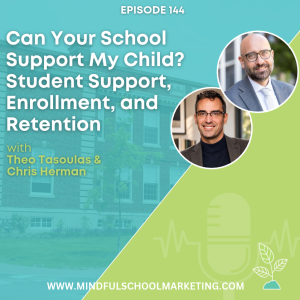
144. Can Your School Support My Child? Student Support, Enrollment, and Retention
When a family asks, “Can your school support my child?” how confident are you in your answer?
For independent schools, supporting students with different learning needs is about more than academics. It’s about enrollment, retention, family trust, and delivering on the promises schools make during admissions.
But what happens when a student’s needs emerge after enrollment? Or when a small school wants to provide additional support but lacks the staffing or resources of a dedicated learning support department?
In this episode of the Mindful School Marketing Podcast, Aubrey Bursch welcomes Theo Tasoulas, founder of Mission Built Schools, and Chris Herman, Head of School at Garden School, to explore how independent schools can build practical student support systems while maintaining academic expectations and strengthening relationships with families.
Together, they discuss:
- How to determine whether your school can truly support a prospective student’s needs
- Practical ways small schools can strengthen student support without large budgets
- What happens when learning differences become apparent after enrollment
- Why communication, teacher training, and clear processes are essential to retention
- How admissions and marketing teams can communicate student support honestly without overpromising
Whether you’re a head of school, admissions director, or marketing professional, this conversation offers practical ideas for creating a school environment where students can thrive, and families feel confident in their decision to enroll and stay.
Podcast: Play in new window | Download
Subscribe: Apple Podcasts | Spotify | Amazon Music | RSS
About Theo Tasoulas and Chris Herman:
Theo Tasoulas is the founder of Mission Built Schools and a former head of school with over 20 years of experience in general and special education. He helps small independent and faith-based schools strengthen enrollment and build practical systems that support students, families, and staff.
Chris Herman is Head of School at Garden School, a nursery–grade 12 independent school in Jackson Heights, Queens. He has a strong background in special education, including a master’s in special and elementary education and experience as a founding faculty member and later Head of School at AIM Academy, which serves students with language-based learning differences.
Find Theo Tasoulas and Chris Herman:
Theo Tasoulas
LinkedIn: www.linkedin.com/in/tgtasoulas/
Website: missionbuiltschools.org
Chris Herman
LinkedIn: www.linkedin.com/in/chris-herman-66a34244
Website: gardenschool.org
Emails: cherman@gardenschool.org
The following content has been automatically generated by an AI system from the audio recording of this podcast. We cannot guarantee the accuracy, or completeness of the information provided, and we apologize for any errors.
[00:00:00] Aubrey: Welcome to Mindful School Marketing, your go-to podcast for personal and professional growth.
[00:00:06] We’re school marketers, business owners, and moms passionate about connecting other school professionals with tools and strategies for success.
[00:00:14] We love solving problems, exploring new ideas, and thinking outside the box.
[00:00:18] Let’s transform your school and life starting right now.
[00:00:22] Welcome to Mindful School Marketing Podcast. I’m Aubrey Bursch. Today we’re talking about something I hear more and more from independent school leaders: how do we support students with different learning needs, especially when we’re working with limited resources? And this isn’t an aca- just an academic conversation, it’s an enrollment conversation, a retention conversation, and ultimately a conversation about the promises we’re making to families and whether we’re equipped to deliver them.
[00:00:45] I’m really excited to have two guests with us today who bring different perspectives to this topic: Theo Tsioulas and founder of Mission Built Schools, and Chris Herman, head of school at Garden School. I’m really excited, Theo and Chris, that you’re here today. But before we dive in, I’d love for you to share with our audience a little bit more about yourself and your journey and your work with schools
[00:01:06] Theodore: thank you so much, Aubrey. So, I’ve spent actually over 20 years in education. My first role was as a teacher in a regular and special education school. After about 10 years teaching, I became the leader of both the regular education and the special education school. And then I– my most recent headship was in a, a pre-K eight faith-based school in New York.
[00:01:26] And like most small schools enrollment really often fell on my desk, so that’s why I started Mission Built Schools to help small, independent, and faith-based schools grow systems and grow enrollment without making it a part-time job for the principal. I do wanna say that I also agree.
[00:01:41] I think that this topic is super, super important. It’s of- often easy to overlook the kind of the connection it has with enrollment because enrollment doesn’t end at dep- at a deposit. You also have to make sure you deliver on those promises in the classroom
[00:01:55] Chris: I’m Chris Herman. I’m the head of school at Garden School in New York City. This is my eighth year here. We’re a nursery through grade 12 independent college prep day school. And before coming here, I was the head of school… I was part of a founding team, and then eventually, the head of school at a, at a school specifically designed for bright children with learning challenges, like dyslexia, in the Philadelphia area.
[00:02:16] Very recently, Garden School here at Garden School, we launched a program called the Bloom Program, which is a school-in-a-school model specifically designed for a small number of bright kids w- who may have dyslexia or dysgraphia and need a, and need an extra layer of support. So this is a really great conversation for us as a school.
[00:02:33] And I think we have a lot to share, too.
[00:02:35] Aubrey: I’m so excited you’re both here and bringing these unique perspectives and experience to the table. So we’re just gonna dive in. So I wanna start with a question I think many, and I, I’ve heard from many independent schools, and it’s like, from… They’re hearing it across the board, and it’s, “Can your school support my child?”
[00:02:53] Right? So Chris, with your perspective and your work with schools and your current school right now, when parents ask that question, what are they really looking for?
[00:03:01] Chris: I I worked for a man for a long time, who was a head of school for, like, 30 years, and he always said that when parents encounter a school, they really just wanna know three things.
[00:03:10] “Do you know my child? Will you know my child? Will you love my child? And will you have a plan for my child?” And so I think when you’re, when you’re hearing that question from families, they really wanna know that you have some level of expertise to understand different k- types of learners. Some level of expertise on not just do you understand them, but do you know what to do to help them?
[00:03:29] And then, you know, they, I think they wanna know w- times will get tough. Every child will encounter a struggle, and that, that you’re, that you’re committed to working with us as a family to support our child.
[00:03:39] Aubrey: That’s so beautifully well put. And I would say when I, when I’m talking to families around this matter too, it is, you know, the- they’ve already been through probably a lot by the time they get to this point.
[00:03:49] So they’re, they’re usually thinking along the lines of, you know, “Reassure me that this is all going to work out essentially, and my child’s gonna be okay and supported.” Theo from your perspective, you know, are you seeing a shift in what families expect from independent schools when it comes to supporting different learning needs?
[00:04:06] And how should schools be responding?
[00:04:08] Theodore: 100%. So actually I’m seeing a couple of shifts for for families. They are definitely way more informed than ever. And I think they’re getting better at advocating as well, for the most part on the whole. They often expect the interesting thing is they expect a small school to know their child really well, which they do.
[00:04:26] But often these small schools don’t have the staffing or resources to provide the level of services that some students who need support would require, and so it’s always that balancing act. Another shift I see is actually Chris kind of, mentioned it, more and more independent schools are being able to service more and more students with needs.
[00:04:45] Whether it’s the case of this really interesting program, Bloom, or just a small Catholic school adding, you know, a student support director and allowing them to really provide better supports. And one last trend, I, I’ve noticed in my as I get more gray, is that the teachers coming out of university now even if they’re not special education trained, they’re way more prepared and un- understanding of the process, and they come out with just a level of understanding that’s really helpful and I think beneficial to school environments.
[00:05:13] So in terms of like the response for schools, you definitely wanna make sure that the school understands clearly understands and defines what the level of support is before they market and then everyone needs to be on the same page. Admissions, whoever handles admissions academics, and leadership.
[00:05:29] Aubrey: Fascinating. Thanks so much for sharing, Theo. I too, when I’m talking to schools, have seen these trends emerge in different ways. So it’s interesting to see the changes that are happening because of those trends and you know, what schools are doing to kind of, I guess, respond to them. So, thank you.
[00:05:46] Chris, now I know you’ve worked in schools specifically designed for students with language-based learning differences, and now you lead perhaps a more traditional independent school. What lessons from these specialized environments do you think every independent school could benefit from?
[00:06:00] Chris: It’s actually, it’s a little bit of answering your last question and, and riffing off of what Theo said, but I, you know, I, I think ano- another really important trend is everybody, every parent is coming to the admissions process looking for personalization.
[00:06:15] That’s sort of like the, the word of the day, I think. And that’s why they’re coming to independent schools and, and I think that you know, in a specialized learning environment, there’s a high level of training in the teaching staff, neuro-informed teaching. And and then like differentiation is just baked into the, into the practice of every classroom.
[00:06:33] And so I think if you could take those notions of what does personalized learning really look like in any environment when you have 10, 12 kids in a room? What what does differentiation look like in a school that you know, was designed 103 years ago? Not with, like, the word differentiation probably didn’t even exist yet.
[00:06:50] And then, you know, how do you take what we know about brains today and apply it to everybody and everybody in the room, not just those that have some kind of specialized need?
[00:06:59] Theodore: Yeah, 100%. And, you know, if I was gonna add on, I would say that some of the greatest teachers I’ve ever seen have been special education teachers.
[00:07:07] I mean, I’ve seen, you know, classrooms with 10 kids, five re- different reading levels, you know, and this p- perfect orchestration of every student hitting, you know, getting what they exactly need, the students working independently and in groups. It’s really… what that takes, though, is really strong planning.
[00:07:25] It takes strong practices, explicit instruction and these are all things that really translate to all teachers, right? And this is definitely, if it’s not present in your school, this is definitely a PD that teachers would actually enjoy, benefit, and use.
[00:07:40] Chris: But it’s PD that goes on for years. So to become a really good special ed teacher, it’s not, you know, it’s…
[00:07:47] It, it takes years. It just takes years to become that adept at making all those instructional moves on purpose. On pur- yeah.
[00:07:55] Aubrey: And I’m curious, a follow-up question is, is like how do we retain … I mean, how do we find people like that and retain them if all the, like, we’re, our expectations or perhaps the needs of the students are changing?
[00:08:07] I often think about the, the challenges schools are facing right now with hiring. I mean, kind of constantly like hiring, and now there’s this added level of, you know, h- you know, you mentioned the skillsets needed and the professional development ongoing needed and, and consistently. I’m curious both of you h- have worked with so many school leaders and, and teachers and in schools what are your thoughts around that?
[00:08:32] Chris: I, you know, I, I think that everybody, every, every teacher in America, in the world wakes up in the morning and says, “I really wanna be- I, I wanna help kids today.” And so I think walking into a school where you can be successful because the admissions team did it right, because the resources are right, because the classroom size is right because you feel like you have the skills to serve the kids in that room I, I- who doesn’t wanna work in an environment where they feel really successful?
[00:08:56] So I think it’s just about, it’s simple. You just have to get all those things right and then everyone will be happy to come to work, right? No big deal, right, Theo?
[00:09:05] Theodore: One, two, three, magic. You know, and I would I think it’s really incumbent upon all school, you know, especially independent schools, they’re so different, right?
[00:09:12] And so, you know, what is your mission? Who do you serve? Why, why do you exist? And what’s your niche, right? So are you, you know, a true special education school that, you know, serves children only with dyslexia? You know, that’s really clear to teachers and parents. Are you a, a small faith-based school that, you know, has this small department and can serve students who provide, gets different services?
[00:09:34] You know, it’s really, you need to be really clear on that. And then what that does is teachers know what they’re, what they’re walking into, right, and what, what needs to get done. Families know what’s happening. And then also your PD, all of that aligns, right? Because you know who you are and you know how you serve kids.
[00:09:51] Chris: Yeah, I think that if I give one piece of advice to people who are new to education or new to leadership is like, it, it look at the mission of the school and really understand what does that, what does that mean in practice, in daily practice. It- we talk about fit, you know, it’s the right fit school in admissions, but it re- really matters for the…
[00:10:09] You’re not gonna be successful at a school that you don’t really fit with the mission.
[00:10:12] Aubrey: Well said. Thank you all for sharing on that. Theo, when we spoke previously, which we enjoyed that, enjoyed that conversation, you shared about how you started building student support at your former school, you know, a- and expanded it as enrollment grew.
[00:10:26] Like, what did that process look like, and what did you learn along the way? I think our audience could, I think especially the schools wondering, like, where, where do I start? How do, how do I do this? They could benefit from hearing about your journey.
[00:10:38] Theodore: Yeah. So I mean, first off, you know, nationally around 15% of public school students receive special education services and, you know, that translate to, translates to the independent school world, right?
[00:10:50] And so at the pre-K to eight school I led that was, you know, students who needed required support were a sig- significant portion of our population. So when I first… my first move was, I mean, I, I felt equipped after my experience of, you know, teaching and leading in a regular and special education school for 10 to, you know, over almost 15 years.
[00:11:09] My first move was to create a coordinator, and it was a part-time position for one of the teachers who had a special ed background. And their main job was to help families kind of navigate the process. I’m sure listeners all over the country, but in New York City s- specifically, it’s, it’s a very big and challenging kind of labyrinth to get services.
[00:11:27] And so what happened was we created processes and procedures around that. As, you know, with teachers, how families communicate how we communicate with families, how, you know, just everything really. But the challenge was we, our enrollment grew 50%, right? And so the number of case loads, you know, doubled.
[00:11:45] And, and I think even at, with families who were advocating more, we were just getting more and more services. So we just, that one position as as initially created couldn’t, couldn’t hold it. So we had to look at making, you know, creating different processes and m- also making it more than a, a full-time, more than a part-time position.
[00:12:02] Aubrey: Thanks for sharing. I would like to shift the conversation, we kinda touched on this, to those smaller independent schools, you know. Smaller independent schools, they don’t necessarily have dedicated learning support departments or large budgets, and people wear multiple hats. What are some practical things schools can put into place to better support students without overwhelming their teachers and staff?
[00:12:23] You know, I’d love to hear from both of you. Theo, can you kick us off? And then Chris I’d love to hear your perspective as well
[00:12:28] Theodore: Yeah. So I think one thing to, you know, to think about is, you know, from a budget perspective, if you know, if one role or a part-time role can allow a school to serve five, 10 or 15% more kids, then, you know, financially the investment does make sense, right?
[00:12:46] If you’re, if you’re not able to provide, you know, even five or 10 families because you just need minimum amount of support, that’s something schools could look at. But I think, you know, a few things come to mind. First, you wanna really make sure that teachers are not operating in you know, in a vacuum by themselves trying to do all this work together.
[00:13:03] So like I said, you know, my first, one of my first tasks was to create the coordinator position. I think even, you know, most schools can figure out a way to create someone who owns coordination and, you know, preferably that’s with a stipend. It’s a part-time role, even, you know, extra time off.
[00:13:20] Figure a way to make it work because you need somebody who’s owning that process. I think another easy thing that we learned along the way was making the referral process documented and simple. And this could really just be a Google Form, you know, that you carefully craft. The benefit there is that the attached spreadsheet to the form can actually be like a tracking system so that you can make sure you’re, you’re following up with the proper– students are getting what they need.
[00:13:46] And last but not least time. So time is the most precious resource for all educators, and as leaders, I think we really need to be intentional. So I, we looked at it two ways with the leadership team. One is making sure you build in recurring meetings, right? That are focused on you know, monitoring the progress of students with support and evaluation process, preferably with the person who’s the coordinator.
[00:14:10] But at least in teacher teams, right? Because the value of great teachers together is immense. But then also when you’re looking at your PD calendar for the year, I think it’s really important to take feedback from your teachers and your leadership teams and then you know, kind of schedule key times throughout the year where teachers work together to evaluate, monitor progress everything tied around student support.
[00:14:32] And an example could be at the beginning of the year, you know, reviewing what special education is versus a 504, how to evaluate a student and so on. And then during the year, maybe after assessments, gathering around, looking at the data of all students, but then also making sure that students who have maybe an ISP or 504 are making adequate progress.
[00:14:52] Chris: And I think that speaks to, like, the, the importance of data. And then there’s also just the, the reality of being a teacher who, say, was trained to teach high school social studies or middle school language arts. You really nev- you were never really trained to identify… to, to, to diagnose and prescribe for, for a learning need.
[00:15:11] And so I, so I think about the importance of that sitting around the table that you were talking about. Just hearing from one teacher to another, like, “Hey, I did this for Theo and it worked. I did this for Theo and it did not work. Don’t, don’t do that. Do this.” I think that tho- just sharing those examples of just sharing those examples of success stories for teachers who really might not even know, oh, like I could…
[00:15:33] There’s a way I can, I can teach two texts at the same time, one on one level and one on another. I don’t do that. I’m a primary source teacher, so I’m always using the Declaration of Independence. Like, but it turns out there are versions written for different reading levels. I, I… The, the other thing I’ll add that I think is newer is that, is that AI is a really powerful tool for regular ed teachers who can, who, given the right prompts, can say, take the Declaration of Independence and p- and make it less challenging.
[00:16:01] Make it, you know, dr- take all tier three words and drop them down to tier one words. Put this on a, This child’s in Wilson at step 4.2, make this decodable. Make… You know, and I, and I think, It’s, I mean, these are the kinds of things that 20 years ago a special ed teacher literally would take, like, all day Sunday.
[00:16:19] Yes. I mean, I used to sit in a closet and record myself reading books aloud so that a student could listen to the book. Yeah. It’s a, it’s a very different world now. It’s a very, it’s a much, it’s a much easier world .
[00:16:30] Theodore: In that respect. And I do wanna a- that’s you took me back to those long days. I do wanna add one thing that you, that you touched upon.
[00:16:37] You know, when you have these te- you know, a, a, one student doesn’t have one teacher, right? They have a gym teacher, they have an art teacher, maybe a, your second language teacher, all of this. And that child is the same throughout, right? So when you’re creating these, you know, systems and these, you know, you know, professional gatherings, it’s really important even if they’re not involved, that they’re cued in and that you have these systems that teachers know, okay, you know, whatever this child needs, how it applies to my classroom and how I can support.
[00:17:03] Chris: And the classroom is so different. Sorry, just keep on going, but, you know, the classroom is so different. If your classroom is a giant gymnasium or your classroom is, your classroom is the lunchroom, like where you’re trying to get this child to pay attention- Yeah … to follow instructions, multi-step directions, it, you know, your classroom could be the blacktop, could be, you know, could be the gym, could be the dining room.
[00:17:24] And so I, I, my f- my first job was as an itinerant support IEP teacher in public school, which meant my job was to have 50 students whose IEPs I like was supposed to understand and manage, which is an insurmountable task. But then to walk around to all of their inclusion teachers with their learning profile and remind them of all the accommodations that they were supposed to give.
[00:17:45] And, you know, it was a middle school, and so these 50 kids each had 10 teachers that didn’t, that really didn’t understand IEPs, didn’t really do accommodations. And so, you know, the the, the, the idea of being able to make sure that the, the gym teacher knows, the PE teacher knows what it means to have ADHD in an environment with these sets of circumstances can be really helpful and free.
[00:18:07] Aubrey: Thank you both so much. I’m curious, you know, I wanna shift a little bit to, you know, admissions and, like, that whole process, which is com- completely… so there’s admissions process, right? And then there’s admissions process when you’re trying to see if you can be the- you’re the school that’s the right fit for a student’s needs.
[00:18:24] So, Theo, knowing the challenges that, you know, that, that ha- you know, that can occur during this process, you know, how can schools navigate that and determine if their school is the best right fit for a student’s need?
[00:18:38] Theodore: Right. So I think first off the question isn’t, you know, can we enroll the student?
[00:18:44] It’s really, can this student access our program and make real progress with the capacity we have? It’s a, it’s a different question but it’s really important. I think that, you know, definitely, you know, the IP or whatever documents are important that, but the diagnos- diagnosis doesn’t tell the whole story.
[00:19:02] So you really need to understand how the, the child’s currently operating, what supports they need, what the family’s expecting, and what you can, you know, really deliver all year. And kind of what we talked about before I think that it’s really important that, again, whoever’s hire- you know, handling admissions and special education and academics and leadership are really all on the same page.
[00:19:22] In a small school, it can very well be, you know, one or two people. But it’s, you wanna make sure that you’re all on the same page. One last thing that I think I, I did wanna add and wanna make sure before I forget is that, you know, if you don’t have these policies or if you do I would really, really encourage all small school leaders to do the investment of providing their policies, their handbook and what- whatever other materials they have to a special ed- to an attorney who specializes in this educational area, just to review and make sure that you’re, you’re following proper protocol.
[00:19:53] Aubrey: That’s a good one, and very practical and, and needed. So thank you for sharing that. Chris, okay, so let’s continue on this admissions piece. Like, a school determines, you know, it might not be the best fit, right? How do you communicate that to families in a way that feels, like, supportive, honest, and respectful?
[00:20:11] Chris: You know, it, it’s, Well, I, I think first, you know, I, I ask our team to ask our, ourselves, you know, under what conditions can this child thrive? Not just can we admit them, but can this child thrive? And then do we have the resources to create those enabling conditions for them to thrive? And if the answer is no…
[00:20:29] And also bear in mind that small independent schools the, the answer might be no to the sibling of a current student. So you’re talking to a family that you’re, you’re both saying, “We’d like to retain you, and we cannot currently serve your other child.” And that’s, these are hard conversations.
[00:20:43] Like, you know, I think it has to come from a place of high emotional, like, actual care. I, I, I think I have said in my career a couple of times it’s unethical for me to take your money for two reasons. One, we don’t actually have what your child needs, and even if, and even if we, if we, if we try to muscle through it, we’re wasting precious time.
[00:21:05] Your child needs tailored, targeted instruction more than every other child, and than another child. And so y- you’re you know, this would be a bad place for you to spend your money. I don’t know. I, I, I think it has to come from a place of, like, you- I love, I love your child. I know your child, I love your child, and the plan…
[00:21:21] You need to make a plan, and I’ll help you with that plan, but it’s not, it’s not here.
[00:21:24] Aubrey: It’s that collaborative. They’re feeling supported by you no matter what the dec- you know, even if the decision is not the one that they were hoping for I think is, is a beautiful way of, of, you know, respecting and acknowledging the, the family and their needs.
[00:21:40] So thank you for sharing. I’m curious I wanna switch a little bit to, you know, retention and families. You know, you know, what happens, like, Chris, I’d love for you to weigh in on this first, and then Theo, jump in. Like, what happens when a students enroll before, you know, a certain learning need becomes apparent?
[00:22:02] I hear this all the time from schools who are like, “Well, you know, they enrolled in pre-K, but by the time we got to third grade, you know, they’re… it’s a completely different child.” Like, it’s what you didn’t know in pre-K now you know in third grade, right? So and the, the child needs additional support.
[00:22:19] How can schools navigate that situation without losing the family’s confidence and, like, also, you know, making sure that they’re continuing that conversation with that, that family?
[00:22:31] Chris: So we’re a, we’re a nursery through grade 12 school, which means you start your enrollment after you turn two, which means that you do your family visit when you’re, like, an actual baby.
[00:22:42] And so, you know, I often like… It’s, it’s funny, you know, when a, when a middle schooler shows up, you can, you can give them a writing prompt. When a, when a, an, a 14-month shows, shows up, you know, like, you can’t even ask… Like, I mean, they can’t even potty-trained, you know? So, like, the idea that you would be able to predict then what this child’s learning is gonna manifest, like, in third grade when, when the rubber really hits the road for reading it’s, it’s impossible.
[00:23:06] I… And I’d say that it’s the, it’s the students who are the brightest who can memorize all the words along the way and kind of, like, hide their struggle until they get to second grade, and they can’t really produce the academic work anymore because they’ve run out of a capacity for faking it. Those are the kids that I, I, I think that we end up finding that we need to support in a, in a small school.
[00:23:29] Because you’re really… Like, you know the children very well when they’re two. You know them very well when they’re three. And you don’t really start spotting the delta between them and their, and their age-related peers until kindergarten, you know. To be honest, everything else is like, “Huh, that’s, that’s, that’s suspicious,” but it’s also age-appropriate.
[00:23:49] You know, a letter reversal a memory for vocabulary words. You know, you’re not even teaching sight words until kindergarten. How do you know, you know?
[00:23:58] Theodore: Yeah. I mean, you know, I think if you, you– we talked about 15% of s-students in the country, you know, have IEPs or have sp-you know, s-special support.
[00:24:07] Backwards design that. So if you’re enrolling in pre-K, pre-K two, three, or even kindergarten, plan for at least around that number to manifest in your classrooms. Usually for us you know, we have kids come in pre-K three in, over different schools or even K. It really rubber met the road from like first, first and second and third grade.
[00:24:28] And that’s where I think it’s super, super critical. So if you’re a small school and you don’t have those systems in place, I think that should be priority number one, not midyear. I mean, let’s be practical in what you can provide. But sit down with your board and leadership team and figure out, okay, you know, what exactly is our process for– what exactly are the services we can provide students in our bui-with our current, you know, setup or maybe with an additional, you know, addition?
[00:24:55] What is the process that we’re gonna use to really make sure we’re proactive, right? And so we’re utilizing data to make, you know, see how students are progressing. We’re u-using a school counselor or whatever other support you have to really provide support for behavioral challenges. And then how do you have those checkpoints?
[00:25:12] How do you communicate with families? And then once that, all those processes are in place, you know, you’re looking at communication on both for your staff, they understand how the how to execute, but then also for families. You know, it’s in your handbook. It’s what on whatever admissions, you know, materials you must, you must have.
[00:25:29] It’s also like really clear and consistent language throughout the process for, for families. You
[00:25:34] Chris: keep on using the word process, and I really appreciate that you’re saying process because I, of all the people in the building, the people who sign up to teach babies to read are the, the least likely to deliver hard news to a family.
[00:25:47] And so I, I think having a really clear process that can en-enable them to share a concern, those are very hard conversations for someone who’s been having them for 25 years to have. No– Now try to imagine being like a relatively young new teacher who only works with these adorable sweet things that you love, you know, and now go tell that mom that there’s something wrong.
[00:26:09] You know, that’s, it’s, it’s not, you know So having this really clear referral process, I think is key.
[00:26:15] Theodore: Yep.
[00:26:16] Aubrey: I couldn’t agree more, having worked with schools who’ve had to have those difficult conversations. It’s like parents don’t go into being a parent thinking that, like, the, the, the path may be different, right?
[00:26:28] The path might be different. As a mom who’s had to travel that path, like, you’re like, “Oh, wow, this is, you know, the path.” And then you’re like, “Nope, I guess it’s not.” And it, it’s, there’s, like, a process that… Having a process in place to handle those, those challenging conversations I think is key to equip the teachers and also it gives the parents more, I think– I think it allows the parents, y- you know, the space to be able to reflect and if there is a process in place instead of, like, it just kind of being this willy-nilly thing where, like, oh, you know, this is a problem, but we don’t actually– aren’t giving you next steps for how to, to move forward.
[00:27:03] So I think it’s a benefit to both people in this
[00:27:06] Theodore: case. And I do– I just wanna highlight one thing. To all the principals out there, you have this beautiful process. You’ve trained the staff. You know, you’ve done everything right. But to be honest, you know, what Aubrey mentioned, it’s, it’s really, it’s both sides, right?
[00:27:21] There’s two sides to the equation, and no matter how much you do, I think there’s always gonna be some families and parents where the pro- it’s really, really challenging, right? Sometimes just to get the evaluation, right, that even to understand, okay, my child might need extra support, that would benefit them.
[00:27:38] But then also, you know, if you’re having those conversations where, you know, the school doesn’t have the ability, you know, the child isn’t thriving in the school’s particular setting, those are hard conversations. And so it’s part– you know, it comes part and parcel with the role. But I think– I just don’t want leaders to think, okay, you know, we have built everything and, you know, we, we’re, it’s humming smoothly.
[00:27:58] Those are gonna be some of the tougher conversations you have.
[00:28:01] Aubrey: Yeah, ’cause it’s about emotion, right? Emotion and, yeah, there’s a lot of, of, of things that parents are going through during that process, too. So thank you for bringing that up. I’d love to shift to marketing enrollment. A lot of the people who listen to this podcast are, you know, school leaders and some of them are specialized in marketing enrollment.
[00:28:17] We are the Mindful School Marketing Podcast. So I, I’m curious. You know, we talk a lot about what makes a school different and why families choose it. How can schools communicate their approach to student support in a s- as a strength without making promises they can’t consistently deliver? Chris, do you wanna kick us off?
[00:28:34] Chris: Yeah, I think, I mean, that’s a, that’s a pretty big question. I, I mean, it really comes back to understanding what you actually do. I… You know, w- when you’re touring a kid around your school, a family around your school, you, you automatically are, like, I guess you’re on the sell, and you want to impress them, and so you want to tell them that you can, you can do what, what they need.
[00:28:55] You often don’t hear, “Well, do you take IEPs?” You know, you don’t hear that until the tour’s wrapping up usually. And then at that point, you know, you’ve already, you’ve already kind of, like, learned to like this child. You’ve already learned to connect with this family. And so I, I think being prepared for that conversation at the end of every tour with a here’s what we do and what we don’t do is, is really important.
[00:29:17] I think lots of schools like to say things like, “We do personalized learning. We believe every child can thrive.” We, you know, these big, broad statements, and actually it’s, it’s really in the nuts and bolts. For us we, I don’t know, we’re kind of proud of the, of our statistic, which is not how many students do we decline enrollment to every year, what’s our acceptance rate, but actually how many families did we coach out of the process ’cause we knew we were the wrong school and we didn’t wanna waste their time.
[00:29:44] Because we, we already care about you when you enter the, when you enter the pipeline in the beginning.
[00:29:48] Aubrey: Well said. Thank you. I’d like to shift to kind of final key takeaways. Like, let’s, let’s talk about, like, practical step. You know, let’s say a school leader is like, “Okay, you know, this has motivated me. You’ve inspired me.” What is, like, one practical step, and I’d love to hear from both of you maybe Theo, you wanna kick us off, like, that, that a, a school can take in the next 30 days?
[00:30:14] Maybe they don’t have a large budget. Maybe, you know, they’re unsure of the next step. What is one practical step that you would encourage them to take?
[00:30:21] Theodore: I think that every school’s different, right? And so, and it’s midyear, so, you know, first pat on the back for, you know, wanting to address this problem ’cause I think…
[00:30:30] or this, you know, this opportunity ’cause it is important. But you, I think you, what you first wanna do is identify, get feedback from your team, teachers, get honest feedback from your staff. Get it all out there, surveys, you know, talks, everything. What’s working? What’s not? What do teachers need? What do families need?
[00:30:47] Get families family feedback too if that’s appropriate to your setting, right? Compile, get your leadership team, compile all that information. Look for patterns. Look for priorities. And then be real with, you know, be real with your time. Be real with, you know, how your school year’s going and what you can accomplish.
[00:31:03] If there’s certain small things that you can, you know, easy wins that you can knock out, great. You know, that’s, it’s one, you know, it’s, it shows it’s progress, it’s movement. You know, you’re not gonna do everything at once and that don’t have to carry that expectation. But then also as we were talking before, once you have that information and you really understand what the pain points are, both big and small, that’s where you start, you know, either develop, embedded in your strat plan and start looking at your summer work.
[00:31:29] Okay, what are we gonna do in year one? Year two, how are we gonna tackle the problem? And really with that kind of that cycle of information, communication, trust, collaboration between families, the leadership, and your team and your staff, which is really incumbent upon the leader to, you know, keep that flowing, I think that’s where you make progress.
[00:31:47] Chris: Well, you asked for one so I’m gonna, I’m gonna give you two practical steps that, that you could take in the next 30 days. One, I think, is just, you know, you talked, you know, you, you talked about process so many times. I just think it it’s, it’s so important. So I think just establishing a regular structured conversation with the faculty around students who are struggling is key.
[00:32:05] You know, asking three or four questions about every, every student. What are we noticing? What have we tried? What’s working? What’s not working? What do we do next? And a second practical strategy, there are tons of really, of really simple diagnostic tools that are, that can be school-wide, the, that you can administer in three minutes or less to every student to just identify, like, where are they.
[00:32:26] And I think in small independent schools where where again, the teachers are not necessarily trained to be special educators just having, like, one piece of norm-referenced data like you, like you would have gotten if you were in a public school. Just having that one piece of data to say like, “Oh, wow, you know, the norm group should be reading 88 words a minute in this grade, and Theo’s only reading 28 words.
[00:32:48] Like, something’s happening here.” And they’re free. You know, m- many of those tools are free.
[00:32:53] Theodore: And you know, I would– If we’re gonna go, so the first 30 days, right? Most likely that might mean budgetary implications, finances, right? Maybe staffing perhaps, right? And that in- that then leaders are responsible for working with governance and making sure that school has the resources it needs, which, which can be, you know, challenging in a small school environment, maybe that you’re, you don’t have full enrollment.
[00:33:16] However, I really, you know, wanna encourage all leaders to think about what they’re, you know, what they’re missing, right? So we kinda talked about it before. If a family leaves in second grade and takes their sibling because we didn’t have a process in place to serve that student, how many tens of thousands of dollars did you just, you know, lose in revenue?
[00:33:37] You know, if, you know, if doing this extra stipend or a part-time role even is gonna allow you to go from, you know, to add another ten, 15, 20 students, then the math, you know, really starts to work out. So, you know, leaders are really, really pressed, and they have so many you know, different competing, you know, things around them and I think that the next step to take this home would be, you know, those kind of financial and budgetary implications.
[00:34:02] Aubrey: Great. Thank you both so much. We’re gonna transition now to rapid fire questions. Are you ready?
[00:34:07] Theodore: Yes.
[00:34:08] Aubrey: Okay. Chris, why don’t you start, kick us off with this one. If you could put one book as mandatory reading in the high school curriculum, what would it be?
[00:34:16] Chris: 1984. AI’s about to take over the world, so we should,
[00:34:19] Theodore: we should,
[00:34:20] Chris: Understand how how to, how to fight back.
[00:34:22] I don’t …
[00:34:22] Aubrey: Love it. Theo?
[00:34:24] Theodore: I would probably go with my, you know, book that stood out in, in high school, which was The Stranger b- by Albert Camus. I think that the themes there really resonate with you know, children at that age.
[00:34:34] Aubrey: Thank you. Great recommendations. Let’s go back to Chris. What’s one app you couldn’t live without?
[00:34:40] Chris: It’s a little goofy. I’m not really a phone guy, but I, I play Tetris almost every day to, like, de-stimulate, so I would have to go with Tetris.
[00:34:47] Aubrey: I love that. S- it’s so funny ’cause I often say my schedule’s like Tetris, and I’m like, “Oh my gosh, wait, will people know what that is?” So- … glad to know people are still playing it.
[00:34:56] Theo, what about you?
[00:34:57] Theodore: You know, to Chris’s previous point ChatGPT. You know, it’s running a business is, has presents a lot of challenges, and if you know how to use it right, you know, and really use it as a thinking partner, it can be a workhorse, an assistant. It’s truly, I mean, it’s really a tremendous tool that will replace everybody in five years.
[00:35:16] Aubrey: Yeah.
[00:35:16] Chris: Read 1984.
[00:35:17] Theodore: Yeah.
[00:35:18] Aubrey: There you go. See? Previous answer. Chris, what are you reading right now?
[00:35:22] Chris: I’m reading a book. It, it is called Trauma Through a Child’s Eye, but it’s, it’s really about, I’m trying to understand more about early, specifically the way that early childhood traumas impact the developing brain.
[00:35:33] Aubrey: Mm.
[00:35:33] Chris: I, I’m particularly curious about medical trauma, actually.
[00:35:36] Aubrey: Interesting. Thank you. Theo?
[00:35:38] Theodore: So I’m actually rereading Steppenwolf by Hermann Hesse, which has been about, like, 20 years since I last read it, and I just, you know, whenever I reread a book, it’s just so interesting on how it lands so different even though the book, you know, has remained the same.
[00:35:54] Aubrey: That’s great. Yeah, I agree with that. Also, watching movies sometimes.
[00:35:58] Theodore: Oh, yeah, yeah.
[00:35:59] Aubrey: Okay. Chris, what’s one last piece of advice you’d like to leave us with?
[00:36:03] Chris: I… You know, just because you have a willingness to help a child doesn’t mean that you have the ability to help that child. The teacher training is the most important thing.
[00:36:13] If you can spend your money anywhere, train, you know, train your teachers so that when your, so that your willingness and your ability can match.
[00:36:19] Aubrey: Thank you. Theo?
[00:36:20] Theodore: I think, you know, as leaders, I, I think really you’re getting inundated with problems every day, right? It’s really important that you’re able to identify and also work with, you know, really lean on your team and your leadership team and staff to identify patterns.
[00:36:36] And so, you know, it might come to the point where you’re not asking, you know, teachers to work harder. You’re identifying something that is, you know, continual, so then it’s incumbent upon you to really start building those systems and procedures and working together to, to support everyone in your community.
[00:36:52] Aubrey: Thank you bo- thank you both so much for being on this episode, for talking about this important topic. I know it’s gonna resonate with our audience. If they wanna connect with you and learn more, where can they find you? Chris, why don’t you kick us off?
[00:37:04] Chris: gardenschool.org.
[00:37:06] Aubrey: Thanks. And Theo?
[00:37:07] Theodore: So I’m on LinkedIn, I’m Theodore Tsoulis.
[00:37:10] Mission Built Schools is missionbuiltschools.org. I’m usually posting practical ideas about enrollment or just stories that I, I can remember throughout my, my time in education.
[00:37:20] Aubrey: Amazing. And we’ll make sure that in the show night- show notes we have linked to everything and how to connect with them. Thank you for being our guests today, and thank you for talking about this topic. I appreciate it. Thank you, Chris and Theo.
[00:37:32] Thanks for joining us on the Mindful School Marketing Podcast. We’d love it if you’d pop into iTunes and leave a review. Five star preferred. Let us know how you like the show. It helps us improve what we’re doing and helps others find us too.
Sing Up For Updates via Email
"*" indicates required fields